Edmond Castle, Hayton, Cumberland
Close to Hayton, in Cumberland, Edmond Castle was the original seat of the Grahams of Edmond Castle.
Most likely, Edmond Castle was originally a peel (pele) tower, the usual kind of defensive tower built
 on the Anglo-Scottish border. According to tradition, it was named after Edmond Graham, its builder, which sounds plausible. It is first mentioned in 1603 in the household accounts of Lord William Howard (published by the Surtees Society), who paid a small sum to Andrew Graham of Edmond Castle. There seems also to have been another reference in a contemporary account, in which Lord William Howard required William Grame, tenement at Emount Castle, to pay 8 shillings and 2 capons [2].
There was clearly quite a community at Edmond Castle in the 1600s and 1700s, not just a single house. T.H.B. Graham [2] says that towards the close of the eighteenth century, there were four family houses at Edmond Castle, in addition to the house where the Grahams of Edmond Castle live.
- Dixon's, which was sold to Thomas (iv) Graham in 1759;
- Willie's House, the property of James Graham of Fenton, whose relationship, if any, to my branch of the Grahams is uncertain. He sold to Thomas (iv) in 1784. Apparently this was the centre of the local smuggling trade, and brandy was sold at fourteen pence a quart.
- Charley Tom's, property of Thomas Graham, alias Charley Tom. He had a son Thomas, who was known as ``young Charley Tom".
- Reed's, occupied by John Nixon, and bought by Thomas (iv) in 1786.
All these houses were demolished at around the same date (presumably soon after 1786) to make way for improvements to the big house, the house of the Grahams of Edmond Castle. By 1796, Dr. John Heysham, a well-known Carlisle doctor and naturalist, was able to comment on the sand martins in the artificial lakes which Thomas (iv) Graham was making [5], so the renovations must have been well under way by then.
The Hayton parish register as transcribed by THB Graham [1] has the earliest legible burial as that of James Graham of Edmond Castle (1628) the earliest baptism that of Christopher, son of John Nixon of Edmond Castle (1650), followed by a host of other Grahams and Dixons (all of Edmond Castle), with an odd name or two thrown in elsewhere. Clearly, in the 1600s there were multiple families of Grahams at Edmond Castle, and at least two Dixon families. T.H.B. Graham [1] believed that Edmond Castle actually formed a separate township of the parish of Hayton.
 The Edmund Castle that exists today (or did, until it was chopped to pieces by developers in 2005 or so) was built by Thomas (vi) Henry Graham (1793-1881; my GGGG Uncle) who married Mary Carnegie in 1829. The building was designed by Sir Robert Smirke between 1824 and 1829. On the external walls of one of the wings is a plaque (shown at the left) to commemorate that. You can see the Graham escallops on the left, and the Carnegie eagle on the right. Above the shield it reads TH 1829 MG(C?).
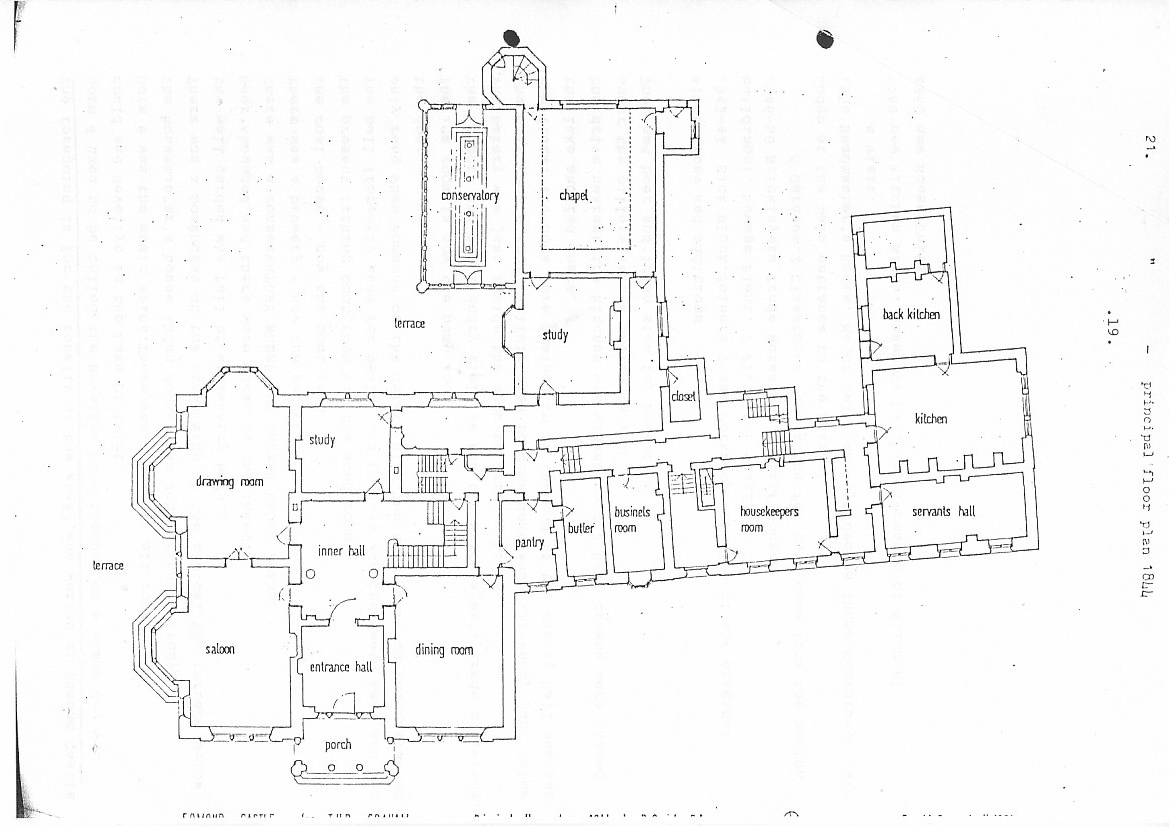
An 1844 floor plan of the ground floor of the castle was sent to me by Ruth Smithson, and can be seen in the photograph gallery.
According to [5], quoting Henry Penfold who wrote for the Carlise Journal in 1915, Thomas (vi) Graham was a great lover of antiquities and the mansion housed an enormous collection, including a lot of works by Landseer, the famous painter of animals. This is hardly surprising given that Thomas's siblings were already teasing him about his collection of antiquities when they wrote the Family Chronicle back in 1818. Apparently, he even erected patriotic memorials here and there on the grounds of Edmond Castle, commemorating (in Latin, no less) the various victories of England (presumably over the benighted heathen. Or possibly the Frogs. Certainly over some dirty foreigners.). From the Family Chronicle one can see he was rather pompous even when younger. He clearly didn't improve.
In 1937 T.H.B. Graham (the author of the articles in Trans. CWAAS) died, and his son Eric Graham inherited. However, he wasn't too keen on Edmond Castle and sold it, with the entire estate and associated cottages. For £38,500 according to the conveyancing deed. They dickered over the deposit. Eric wanted £3,850, the buyers wanted to pay £500, and they settled on £1,000. Nothing much changes, huh?
The new owners, Henry Studholme Cartmell and Stanley Walton then allowed the Castle to be used as a home for Czech refugees, starting around the 21st of June, 1940. (One refugee was Hedy Fromings, and I even found a photo album of a bunch of young Czechs at the Castle. Unfortunately, the link to the photos is now broken, and I didn't take any copies.). Ruth Smithson sent me copies of some of the letters of complaint written about the refugees, who, apparently, left gates open (horror! Sometimes twice a day!), interfered with rabbit traps (Oh No!), used Ruddick's spring cart and broke a shaft (unimaginable disaster!), and generally trespassed where they weren't supposed to. It's a delightful set of letters.
When the Czech refugees left, the Castle was used as a home for delinquent boys, but I don't know much about that period. The school trained delinquent boys in plastering, plumbing, painting, joinery and bricklaying, employing them to carry out repairs on the property and painting murals of rock’n roll singers, cowboys and undersea discovery. I do know that, during the latter stages of the war, my grandfather (Alfred Sneyd, or Pop) visited Edmond Castle when it was a Borstal, and gave a talk to the boys. He was in the New Zealand Navy. Presumably he was sent by my grandmother, who was the Graham descendant and never let anyone forget it. Especially not her husband.
The Castle was later turned into a hotel, called Hayton Castle Hotel, but I don't know when. Certainly before 1990, when I visited and took some photographs.
In 2005, Edmond Castle was sold again, broken up by developer David Dyke and sold. Below I've copied the For Sale notice in the Times Online. If I had had the money, I would have bought it. I wasn't even close.
I visited Edmond Castle again in August, 2005, when the builders were there to do Dyke's dirty work. A terrible shame. The house was being broken up and sold off in pieces; a bit here, a bit there, a two-bedroom apartment in this bit, a four-bedroom apartment in this bit. Walls were being built to break the garden up and I just hate to think of the damage being done inside. Soon there'll be essentially nothing left of the grand old house it used to be. Ah well. Nothing I can do about it. As Dad said, if you had the money you'd buy it, but then you might have to live there and you wouldn't want that. Imagine having to live in Britain. Shudder.
I took a bunch of photographs both times, and a selection can be seen here.
For Sale
When Edmond Castle was put up for sale most recently, the following description was written by Marcus Binney in 2005. It's so good I reproduce it (almost) verbatim.
February 04, 2005
Good manors
Castle made to border
by marcus binney of the times
A fortress marauding Scots is now an essay in architecture
OPPORTUNITIES to buy Georgian country houses by famous architects are rare - especially at a price of £875,000. Hayton Hall, which stands in rolling country east of Carlisle, was designed by Sir Robert Smirke, the architect of the British Museum, and sensitively extended by his younger brother, Sydney.
Although Smirke is best known for grand Classical public buildings, here he designed a pioneer essay in Tudor Revival, the style adopted a decade later for the Houses of Parliament. There are hoodmoulds to the windows, pretty shaped gables and a porch with a trio of slender Gothic arches topped by pinnacles inspired by those on Henry VII's chapel at Westminster Abbey. But the Gothic is only skin-deep; this is really a very spacious Regency house with tall sash windows and lofty ceilings.
The added appeal of Hayton is that it is built of a very pretty, buff-coloured local sandstone with crisp, carved detail. The entrance front is neatly symmetrical, but picturesque elements are added with large bay windows on the west front and an ogee-domed lookout tower at the back. In the stable yard is a pele tower, one of the tall, square fortified towers found all over Northumberland and built as a defence against marauding Scots. In previous centuries Hayton was known as Edmond Castle, reflecting its role as a border stronghold. Smirke was employed by Thomas Henry Graham, whose family had owned the estate since the 17th century. Graham lived the comfortable life of a local squire, completing an astonishing 65 years as a magistrate before his death in 1881. Intriguingly, he commissioned Smirke to build his new house when he was just 30 years old, in 1824, the year he was High Sheriff.
Graham was devout, adding a new chancel to the church in the village of Hayton half a mile away. To ensure that he never missed a service, even in deep snow, he built a charming stone house in Norman style next to the church. The home had a pyramid-topped tower, and the family and servants would arrive there for the day each Sunday. He also built a chapel and parsonage in the village of Talkin, Cumbria.
Eric Graham, who inherited the house in 1937, had no children and obtained permission to break the entail that bound the estate to be handed down from one generation to another. A consortium of local businessmen bought the house and 51,000 acres for £7,500.
Fortunately they did not simply sell the timber and demolish the house, as often happened in the 1930s Depression, but sold the hall to the Home Office in 1942 for use as an approved school, having allowed Czech refugees to take shelter there in 1940. The school trained delinquent boys (as they were then called) in plastering, plumbing, painting, joinery and bricklaying, employing them to carry out repairs on the property and painting murals of rock'n roll singers, cowboys and undersea discovery.
When the school closed, Hayton was taken over as a country-house hotel. The underbidder was David Dyke, who instead bought a staff accommodation block and converted it into eight flats, selling one to a circuit judge. A year ago Dyke, 30 years after he first came to Hayton, fulfilled a dream by buying the rest of the estate ...
He says of Hayton Hall: "I wanted to keep the main house intact. It's simply not suitable for horizontal division into apartments." The Sydney Smirke wing set back on the east is intended as a separate house, although one potential purchaser expressed interest in combining the two. Farther back, the chapel will become another self-contained house, with a conservatory on the exact site of the one that Sydney Smirke designed. The stables will be converted into 15 smaller houses and cottages. The architects are the London practice of Casson Conder, where Dyke's daughter, Tina, is a partner.
Below the house is a delightful lake complete with small island and now restocked with fish. That will be shared between the residents, as will some 30 acres of woodland walks. The long drive is also shared, but Hayton Hall has its own drive up to the house, with lawns on three sides. The front door opens into a large entrance hall, with Doric columns framing the view through to a grand staircase. The latter has an impressive cast -iron balustrade lit by a grand twin-lancet window on the half-landing.
The main rooms on the ground floor are designed to provide a circuit for entertaining, with one room leading to another. The double drawing room on the west is as brilliantly lit as a conservatory, with sashes and bay windows descending almost to the floor. In one bay French windows lead into the garden, in the other the sash is so tall that you can stroll through it. Smirke's cornices are as crisp as if they were chiselled in stone and the beams are adorned with guilloches (a circling rope motif). The dining room is a place for serious candlelit dinners. Upstairs the landing has a pretty Rococo white marble fireplace. The seven bedrooms have bathrooms that were added when the house was a hotel; the temptation is to remove some of the partitions and to return subdivided rooms to their elegant Regency proportions.
One big surprise is the attic, adapted for a ballet dancer with a large practice floor under the roof but also suitable as a games room. It has a separate staircase and makes an unusual penthouse flat, with bedrooms shaped like tents nestling under steeply sloping eaves.
References
[1] T.H.B. Graham, An old Map of Hayton Manor, Transactions of the Cumberland and Westmorland Antiquities and Archaeological Society, N.S. VII, p. 42. (1907)
[2] T.H.B. Graham, The Old Village of Edmond Castle, Transactions of the Cumberland and Westmorland Antiquities and Archaeological Society, N.S. VIII, p. 13. (1908)
[3] T.H.B. Graham, The Parish of Hayton, Transactions of the Cumberland and Westmorland Antiquities and Archaeological Society, N.S. VIII, p. 55. (1908)
[4] T.H.B. Graham, Annals of Hayton, Transactions of the Cumberland and Westmorland Antiquities and Archaeological Society, N.S. XXV, p. 311. (1925)
[5] Graham’s Home was their Castle, an article by W.T. McIntire, published in The Cumberland Press, in 1939. It was republished on 2 July, 2010.